Blog
7 Things to Look for When Buying Cotton Bath Towels

Buying cotton bath towels is easy to get wrong, because the things that decide whether a towel lasts are mostly invisible on the shelf. These seven checks take a minute each and save years of disappointment.
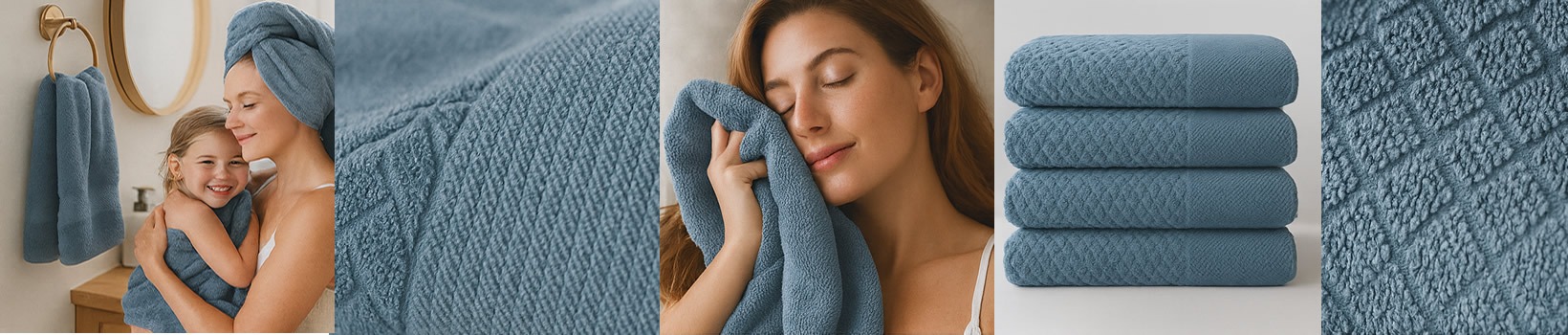
Luxury 100% Cotton Bath Towels 600GSM Large 75×150 cm
7 Things to Look for When Buying Cotton Bath Towels in the UK
Buying towels is not just about how soft they feel in the shop. A towel you use every day gets washed a hundred times a year, and the things that decide whether it still works in five years are mostly invisible at the point of purchase. Here are the seven that actually matter.
1. 100% cotton material
Check the composition label rather than the marketing copy. “Cotton-rich” or “cotton blend” usually means polyester has been added to cut cost, and polyester does not absorb water — it pushes it around. Even a modest 20% synthetic content noticeably reduces how dry a towel gets you.
Look for 100% cotton, and ideally ring-spun or combed cotton. Combing removes the short fibres before spinning, which is what stops a towel shedding lint all over your bathroom for its first month.
2. GSM weight
GSM is grams per square metre, and it tells you how much cotton is packed into the pile. For everyday bathroom towels, 500–700 GSM is the sweet spot. Below roughly 400 you are into gym and travel territory: fast-drying but thin. Above 800 the towel becomes heavy, slow to dry and awkward to launder.
IZORRA towels are 600 GSM, which is dense enough to feel genuinely plush while still drying properly on a normal rail. For a fuller breakdown, see our guide to what GSM means in towels.
3. Absorbency
Cotton absorbs because the fibre itself takes water into its structure, and because terry loops hold more of it across a large surface area. Density and fibre quality together decide how much a towel can take up.
One thing that catches people out: almost every new towel repels water slightly, because of a finish applied during manufacturing. That is normal and washes out. Judge absorbency after two or three washes, not on the first use.
4. Durability
Towels almost always fail at the edges first. A double-turned hem — folded twice before stitching — lasts far longer than a single fold, and the long sides should have a woven selvedge rather than a cut-and-stitched edge that can unravel.
The flat woven band near each end, called the dobby border, is structural rather than decorative: it stops the pile pulling away from the hem and helps the towel hang straight. Our guide on what makes a good cotton bath towel covers how to inspect these before you buy.
5. Softness
Softness comes from fibre length and how the yarn is twisted. Long-staple cotton has fewer exposed fibre ends, so it feels smoother and sheds less. Low-twist and zero-twist yarns put more fibre surface against your skin, which feels plusher, though very low twist trades away some longevity.
The fastest way to ruin a soft towel is fabric softener. It works by depositing a waxy coating, which is precisely the wrong thing to do to a fabric whose job is absorbing water. If you want softness, a splash of white vinegar in the rinse does the job without the coating.
6. Drying speed
This matters more in UK homes than most buying guides admit. Many bathrooms are small, poorly ventilated and cold for much of the year. A very heavy towel that never quite dries between uses will start to smell musty regardless of how good the cotton is.
Be honest about your setup. With a heated rail and decent airflow, 600–700 GSM is comfortable. Without either, staying nearer 500 GSM, or simply owning enough towels to rotate properly, matters more than buying the thickest option on the shelf.
7. Eco-friendly options
Organic cotton is grown without synthetic pesticides, and OEKO-TEX certification confirms the finished fabric has been tested for harmful substances. Both are worth looking for, though neither is a guarantee of quality on its own.
The larger environmental factor is simply how long the towel lasts. Cotton is water-intensive to grow, so one well-made towel used for a decade is a considerably better outcome than three cheap ones binned in the same period. Cotton is also biodegradable and, unlike microfibre, sheds no plastic into wastewater — a point we cover in cotton versus microfibre towels.
Expert tip
Avoid cheap towels made with short fibres. They shed lint heavily, thin out quickly at the centre, and stop absorbing long before they look worn. The cost per year is almost always higher than buying well once.
The seven-point checklist
- Composition reads 100% cotton, ideally combed or ring-spun
- GSM between 500 and 700 for bathroom use
- Absorbency judged after two or three washes, not straight out of the packet
- Double-turned hems, tight stitching and a woven selvedge
- Long-staple cotton, and no fabric softener once you get it home
- A weight your bathroom can actually dry between uses
- Organic or OEKO-TEX certification where available, and build quality that lasts
Ready to buy? Browse our luxury bath towel range, or see our picks for the best cotton bath towels in the UK.