🚚 Free UK delivery on every order · 30-day returns · UK customer support · Secure checkout

Bone Conduction vs Air Conduction Headphones: Which Is Best for Running?

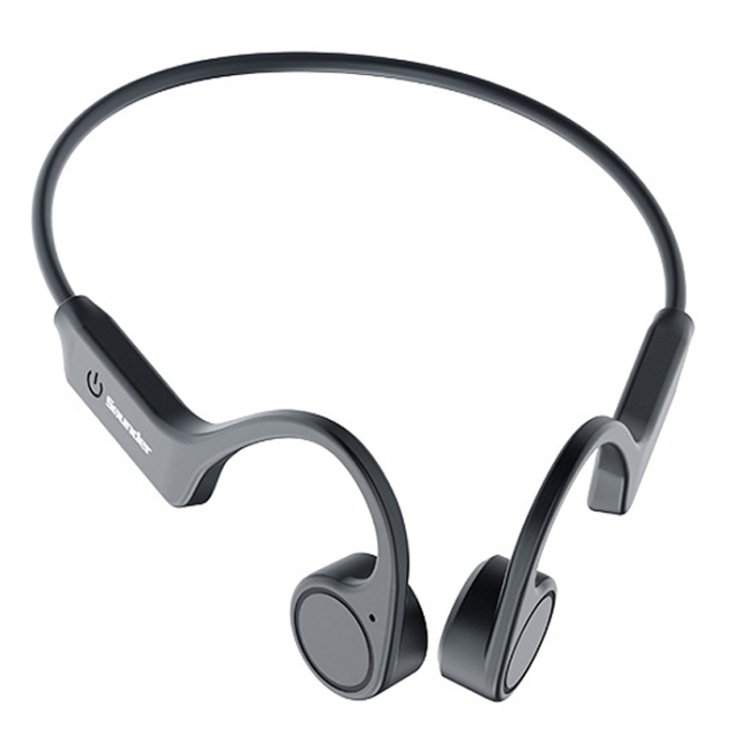
Quick answer: Bone conduction headphones send sound as gentle vibrations through your cheekbones, so nothing sits in or over your ear. Air conduction open-ear headphones use a small speaker just outside the ear. Both keep your ears open for traffic and people around you. Bone conduction leaks less sound and suits wet, sweaty sport. Air conduction gives fuller sound and more bass for the money.
At a glance
| Bone conduction | Air conduction (open-ear) | |
|---|---|---|
| How sound reaches you | Vibrations through the cheekbones | Directional speaker outside the ear |
| Ears open to traffic? | Yes | Yes |
| Sound quality and bass | Clear voices, lighter bass | Fuller sound, more bass |
| Sound leakage | Low | Low to moderate at high volume |
| Feel | Slight tickle at high volume | No vibration |
| Best for | Running, cycling, triathlon training, swimming (IP68 models) | Running, gym, walking, office |
How does bone conduction work?
Small transducers rest on your cheekbones, just in front of each ear. They vibrate, and the vibrations travel through the bone to your inner ear, which hears them as sound. Your ear canal stays completely free, so you hear traffic, cyclists and your running partner as normal.
How does air conduction open-ear work?
An air conduction headphone has a normal speaker driver, often 14 to 16 mm, in a small pod that sits next to your ear canal without going inside it. Directional design points the sound into your ear and limits what escapes. Read more in our open-ear earbuds guide.
Which is better for running?
- If you run on roads in all weather, bone conduction is hard to beat: a light wrap-around band stays put and very little sound escapes.
- If you want better music quality on easy runs and gym sessions, choose air conduction for richer sound and more bass.
- If you also swim, choose an IP68 bone conduction model. The GCRT-X6 is IP68 and has 16 GB of built-in memory, so it can play music without a phone.
Whatever you choose, keep the volume low enough to hear traffic, sirens and people around you.
What to look for
Water and sweat resistance
IP5 or IPX5 handles sweat and rain. IP68 means the headphones are dust tight and can be submerged, which suits swimmers.
Battery life
Bone conduction headphones in this price range usually give around 6 to 8 hours. Open-ear air conduction buds give 5 to 14 hours depending on size. The K23 lasts around 14 hours at medium volume.
Calls
All the models below have microphones for calls, except where noted. Because your ears are open, you hear your own voice naturally.
Multipoint
The Sounder GCRT-X4 connects to two devices at once, such as a phone and a smartwatch.
Bone and air conduction headphones on IZORRA
| Model | Type | Battery | Water rating | Bluetooth | Stand-out feature |
|---|---|---|---|---|---|
| Sounder GCRT-X4 | Bone conduction | About 8 hours | IP5 | 5.0 | Connects to two devices |
| GCRT-X6 | Bone conduction | About 2.5 h to charge | IP68 | 5.3 | 16 GB memory, swim-proof |
| K23 | Air conduction | About 14 hours | Not stated | 5.3 | Long battery, 16.2 mm driver |
| F16 | Air conduction | About 7 hours | Not stated | 5.4 | Four colours |
| Hileo HI76 | Air conduction | About 7 hours | IPX5 | 5.4 | 14.2 mm driver, 360° sound |
Our picks
Best bone conduction for road running: Sounder GCRT-X4
Light titanium-colour frame, around 8 hours of playback and multipoint pairing. See the GCRT-X4.
Best for swimmers and triathletes: GCRT-X6
IP68 protection and built-in storage so you can leave your phone behind. See the GCRT-X6.
Best sound for the money: Hileo HI76
A large 14.2 mm driver, IPX5 and a secure sports fit. See the HI76.
Longest battery: K23
Around 14 hours of music at medium volume for long walks and workdays. See the K23.
More options in headphones and earbuds, or compare formats in headphones vs earbuds.
Frequently asked questions
Is bone conduction bad for your ears?
Bone conduction does not put anything in your ear canal, and at sensible volume it is comfortable for most people. As with any headphones, long listening at high volume can affect hearing, so keep the volume moderate.
Can other people hear bone conduction headphones?
Very little at normal volume. At maximum volume, someone right next to you in a quiet room may hear a faint sound.
Do bone conduction headphones have good bass?
Bass is lighter than in sealed earbuds or air conduction open-ear headphones. Voices, podcasts and most music are clear.
Can I swim with bone conduction headphones?
Only with an IP68 model, such as the GCRT-X6, which also has built-in memory because Bluetooth does not work well under water.
Are bone conduction headphones good for cycling?
They are a popular choice because your ears stay open to traffic. Keep the volume low enough to hear what is around you.
Do they work with iPhone and Android?
Yes. All models here connect over standard Bluetooth to iPhone, Android and most smartwatches with music support.